Your Taproom Doesn’t Need a Kitchen. It Needs 8 Minutes.
Here’s a number that should change how you think about your taproom: 86%. That’s how much higher the average tab is when a brewery visit includes food. Not a little higher. Not “meaningfully higher.” Eighty-six percent. And yet most taprooms still don’t have a real food program. The reasons are familiar — upfront equipment costs, the headache of hiring culinary staff, fear of waste. All legitimate concerns. But here’s what the data and a growing number of craft brewery operators are proving out in 2026: you don’t need a kitchen to run a taproom food program. You need the right product, the right setup, and about eight minutes.
The Real Cost of Not Serving Food
Most taproom owners think about food as an expense. The better frame is this: every guest who walks in without a food option is a guest whose tab is limited by their thirst — and nothing else.
Beer carries an 80–90% gross margin in your taproom. That’s exceptional. But a customer who arrives at 4pm, has two beers, and leaves by 5:30 because they’re getting hungry? That’s a capped transaction.
Add food — even simple, low-prep food — and two things happen simultaneously. First, guests stay longer. Second, the social friction of a third or fourth beer disappears because now there’s something to eat alongside it. The economics are straightforward. A taproom doing 200 covers on a Saturday sees that number differently when 60% of guests have a $4–6 snack alongside their flight. The math adds up faster than most operators expect.
The question isn’t whether food increases revenue. It does. The question is how to offer it without adding operational complexity you don’t have bandwidth for.
Why Most Taproom Food Programs Fail Before They Start
There’s a pattern we’ve seen repeatedly when talking to brewery operators across Colorado and the Carolinas. They know they need food. They’ve thought about it. They’ve even priced out equipment.
And then nothing happens.
Here’s why: the traditional model for adding food to a taproom is genuinely hard. You’re looking at equipment costs of $15,000 to $50,000 before you’ve made a single dollar. A trained line cook starting at $18–22/hour plus benefits. Permit upgrades that take time and money depending on your state. And perishable prep that means unsold food equals lost margin, not just lost revenue.
The result is that launching food the “right” way feels like opening a second business inside your first one. For most independent taprooms, that’s a non-starter.
But that’s the old model. The no-kitchen food program flips all of this.
What a No-Kitchen Taproom Food Program Actually Looks Like
The no-kitchen model works on a simple principle: use products that are engineered to perform without culinary expertise. Frozen-to-fresh formats that go from a chest freezer to a standard convection oven in under ten minutes, require no prep, no training beyond a one-time walkthrough, and hold quality for 90 minutes or more post-cook.
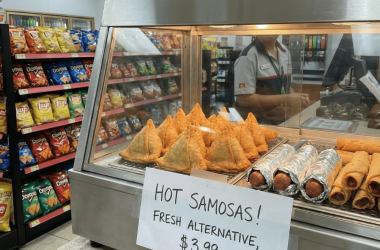
In practice, a taproom running this model looks like this. Product arrives frozen and sits in an existing chest freezer — no additional equipment needed. Staff batch-preps 20–30 units before peak hours. Actual active time: under 10 minutes. Product holds in a warming basket for 90–120 minutes without quality loss. Guests order at the bar with no separate food ordering flow, no tickets, no kitchen expediting. You’ve added a revenue line with zero new hires.
For a full breakdown of hold times, placement strategy, and repeat purchase triggers, see our Hot Case Playbook.
The format that works consistently across taprooms? Grab-and-go snacks with bold, shareable flavor profiles. Warm, hand-held food that pairs naturally with beer and doesn’t require a fork. Which is exactly where samosas come in.
Why Samosas Are the Perfect Taproom Food in 2026
This isn’t a trend prediction. It’s already happening.
Indian cuisine has grown 113% in U.S. restaurants over the past six years. Michelin-starred Indian restaurants are selling out weeks in advance. Fusion formats — samosa sliders, tikka flatbreads, chutney-glazed wings — are appearing on menus from fast-casual to fine dining. Regional Indian cuisines are being called the next big global flavor trend — and it’s no longer just a forecast. It’s fact on the ground.
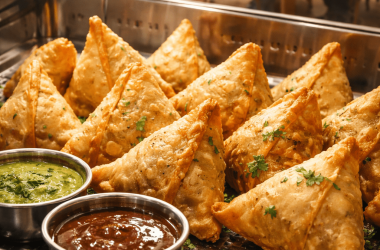
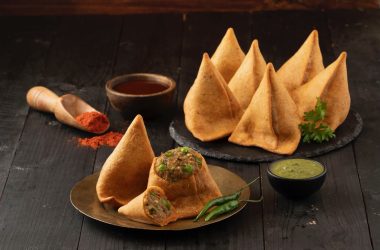
For taprooms specifically, samosas check every box. Spiced filling and flaky pastry pair naturally with IPAs, lagers, and sours. They’re hand-held, no fork needed, and easy to share at the table. They go from frozen to ready in 6–8 minutes with zero culinary skill required. They generate 60–65% gross margin at $3.99–$5.99 retail. They hold 90–120 minutes without quality loss. And guests consistently order multiples — which drives higher per-table spend.
There’s also a differentiation factor worth naming. A taproom that serves samosas is having a different conversation than one serving pretzels or chips. Guests remember it. They mention it when they recommend your spot. They come back specifically for it.
The 1,200-year journey that brought samosas from 9th-century Persia to American taproom bars is worth knowing — read the full origin story here. But the reason they work in your venue in 2026 is simpler: great flavor, minimal effort, and margins that make sense.
The Numbers — What to Expect in Year One
Let’s ground this in real math for a mid-sized taproom. Assume 250 guests per week across taproom and patio. A 25% food attach rate — meaning one in four guests buys a food item. Average item price of $4.99. Your cost per unit: roughly $1.75. Gross margin per unit: around 65%.
That’s about 62 units sold per week, $309 in weekly food revenue, and roughly $201 in weekly gross profit. Annualized: ~$10,450 in additional gross profit.
And that’s the conservative floor. It doesn’t account for increased dwell time and additional beer pours, higher per-visit spend from guests who stay longer, or the taproom visits you’re currently losing to the restaurant next door because your guests are hungry and you have nothing to offer. The ceiling is considerably higher. The floor is still solidly positive — with no new hire, no equipment loan, and no permits required.
How to Launch Your Taproom Food Program This Month
You don’t need a planning committee. Here’s the actual sequence.
Book a free tasting.
Before any commitment, try the product with your staff. Any wholesale partner worth working with will come to your taproom. This should cost you nothing and take less than an hour.
Identify your warm hold solution.
A $200–400 countertop food warmer or heat lamp display is sufficient to start. If you have a convection oven in a back-of-house area, you already have everything you need to cook.
Pick 2–3 SKUs.
Don’t over-assemble the menu. A classic vegetable option, a meat option, and a dipping sauce cover 90% of guest preferences without creating inventory complexity or decision fatigue.
Train your bar staff in one session.
Batch cook timing, hold display setup, and reorder triggers. This walkthrough takes 30 minutes, once. Any member of your bar team can run it after that.
Set your par and reorder trigger.
Based on your peak traffic, determine how many units to cook before each rush. Build the reorder into your existing inventory rhythm — it behaves exactly like restocking any other bar product.
That’s the program. No permits, no equipment loans, no new hires. Curious what this looks like across different venue types? See what operators shared at SE Petro — a lot of the same questions come up, and the answers translate directly to the taproom context.
Questions Taproom Operators Actually Ask
How long do samosas actually hold in a warm display?
Ninety to one hundred twenty minutes before you start seeing quality decline. That window works perfectly with how most taprooms batch-prep before a rush and run through product during peak hours.
Do we need any special equipment?
No. A standard convection oven — which most taprooms already have in a prep or back-of-house area — is all you need to cook. A $200–400 countertop warmer or heat lamp holds the product. That’s it.
How long does training take?
For bar staff, under five minutes. For a manager learning the full system — cook protocol, hold setup, reorder triggers — under thirty minutes. We built it this way on purpose because we know how busy you are and how limited your bandwidth is.
Will our customers actually order it?
Indian cuisine has grown 113% in U.S. restaurants over six years. Your customers already know and love these flavors. The question isn’t whether they want it — it’s whether you’re offering it. The operators who’ve been skeptical have been the most surprised by repeat purchase rates.
Where can we see real data from other taprooms?
Head to tuktook.com/wholesale. Real numbers from real operators. Not projections. Actual performance from venues like yours.
Why This Matters
The taproom is the next frontier for Indian food in America. The market is ready. Consumers are curious. Brewery operators are looking for food solutions that fit their existing operation — not ones that require a new business inside their business.
You don’t need to convince your guests that Indian food is good. They know that. You need a product that solves the operational problem that stops most taprooms from ever launching food at all. That’s the conversation that actually moves the needle.
The 86% tab-lift stat isn’t magic. It’s what happens when guests have a reason to stay, order more, and come back. The only thing it costs you is 45 minutes and an open oven.
Book a free tasting → We’ll bring the samosas to you, your staff eats for free, and you decide if the numbers make sense. No commitment. No invoice.