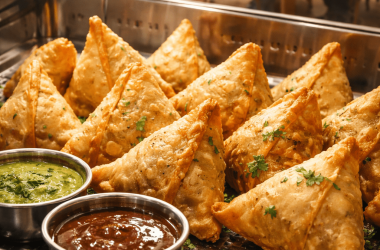
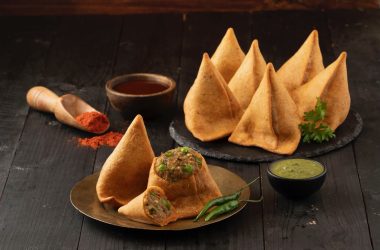
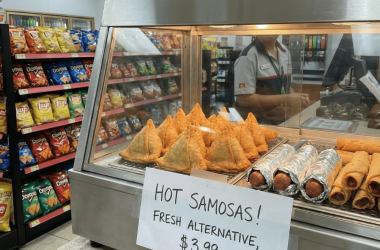
We spent three days at SE Petro Food Marketing Expo talking to 500+ convenience store operators. Every single one told us the same thing: they don’t care about your product’s story or your brand. They care about whether your samosa will hold up in a hot case for 90 to 120 minutes without falling apart, whether they can train their staff in 30 minutes without complicating their already chaotic operation, and whether other stores are actually selling it and making money. Turns out when you’re honest about what your product does (and doesn’t do), solve the operational problems that kill every other ethnic snack, and show real data from real stores, operators listen. The chutney helps too.
We Went to a Trade Show and Learned What Actually Matters
Three days in Myrtle Beach. Hundreds of conversations. We sponsored SE Petro Food Marketing Expo and set up a booth to talk to convenience store operators about hot food. Not the formal, polished kind of conversations you have in a booth. The real ones. We hosted a happy hour where people would actually tell us what keeps them up at night.
The pattern became obvious pretty quickly. Whether someone ran three stores or three hundred, they were asking the same questions. Not “how much is your product?” or “what makes your brand special?” But “will this actually work in my operation?” That’s the question that matters. That’s the one that decides whether a product sits on a shelf or moves through your hot case all day long.
We learned more in three days than we could have in a year of surveys. Here’s what 500+ operators actually care about.
Nobody Asks About Your Brand Story
The first conversation went like this. A guy manages a chain of about thirty stores. Takes a bite of the samosa. Sets it down. Looks at us and says: “The margin math checks out. But how long will it actually hold in a hot case?”
We heard that exact question, or some version of it, dozens of times that weekend. It makes sense. These operators understand margins better than most Wall Street analysts. They’ve been pitched by food vendors before. A lot of them have been burned by products that looked good in the sample but fell apart operationally.
So they don’t trust marketing. They trust transparency. They trust someone who can look them in the eye and say “here’s what works, here’s what doesn’t, here’s exactly where the quality drops off.”
The 90-to-120 Minute Window Changes Everything
For samosas, there’s a window. Ninety to one hundred twenty minutes. You stay inside that window and the product is solid. The exterior stays crispy. The filling doesn’t dry out. It tastes like what you wanted to taste. Go beyond that? Quality starts dropping.
Why does this matter so much to operators? Because most convenience stores don’t prep all day long. They prep once. Usually in the morning. They load the hot case and it runs from open to close. If your product can only sit for thirty minutes before it starts falling apart, you’ve got a math problem that higher margins won’t fix. The operator would need to prep multiple times a day, train staff on a complex rotation, and deal with waste when products don’t sell. That’s operational chaos in an already chaotic environment.
We didn’t just tell operators about the ninety to one hundred twenty minute window. We showed them. We came with fresh samosas and we talked about exactly when and where quality starts to decline. And we were honest about it. Operators who’d had bad experiences with soggy samosas from other vendors—and a lot of them had—they trusted that honesty more than anything we could have promised.
That’s when we started seeing real interest. Not because samosas are magical. But because we solved the fundamental operational problem that killed every other international snack they’d tried.
The 30-Minute Training Rule Is Non-Negotiable
Every single operator said something like this: “If I can’t train someone in 30 minutes, I can’t sell it to my team.”
They’re not being difficult. They’re being realistic.
Convenience store work is controlled chaos. You’re managing point of sale systems, inventory, cleaning, compliance, staffing, everything at once. If you ask a store manager to learn a complicated prep process on top of that, you’re not competing for their attention with just one priority. You’re competing with ten. Your product loses.
The products that actually work are the ones that fit into what they’re already doing. Simple beats complicated every single time.
For samosas, training looks like this: Open the package. Thirty seconds. Put it in the hot case. Fifteen seconds. Brief instructions for reheating the chutney if they want it warm. Two minutes. Ring it up on the register. One minute. Total time to train a new person? Under five minutes. Train a manager on the whole process? Under thirty minutes.
We watched other vendors pitch products that required multi-step prep sequences. Marinade this, cook that, assemble these components. Those products sit on shelves and collect dust. The operators nod politely, take the brochure, and never call back. Complexity kills adoption. It’s that simple.
Format Matters Way More Than You’d Think
We heard this concern repeatedly: “We tried ethnic snacks before and they didn’t sell.”
That’s a fair objection. There’s a huge difference between impressing someone at a trade show and actually moving product in a suburban convenience store on a Tuesday morning at seven AM when people are grabbing coffee and a quick bite.
But here’s what shifted how operators thought about samosas. One guy said it perfectly: “The flavor is new. The operation isn’t.”
Samosas don’t require a new way of operating. They work with what’s already built into a convenience store’s infrastructure. They’re handheld, like a burrito or empanada. Customers already know that format. They know what to do with it. They grab it, pay, and go. There’s no confusion.
They’re crispy and you can batch prep them. That’s literally what a hot case is built for. You’re not asking operators to learn new cooking techniques or buy new equipment.
The shape is familiar. Even if someone has never seen a samosa before, they recognize it as something you grab and eat. It doesn’t look weird or intimidating.
And crucially—unlike a lot of other international snacks—they don’t get soggy when they sit. That was the killer for every other ethnic snack these operators had tried. They’d sit in the hot case, absorb moisture, fall apart. Samosas have a structural integrity that survives the hot case environment.
That’s why operators who’d rejected other ethnic snacks got interested in samosas. It wasn’t about the samosa category. It was that we solved the operational problem that destroyed everything else.
The Chutney Changes the Economics
More than one operator said this without us bringing it up: “The chutney changes everything.”
At three ninety-nine in a convenience store, you’re competing with hot dogs and roller grill items. A samosa by itself, as good as it is, doesn’t communicate premium experience. The chutney does.
Fresh cilantro mint chutney. Tamarind chutney. When someone bites into a samosa with fresh chutney, it feels like restaurant quality. That’s why the price point works. That’s why people come back. That’s why operators can justify carrying it when margins are tighter than they’d like.
Operators figured this out by tasting it. We didn’t even have to tell them. They understood immediately that the chutney wasn’t an extra add-on. It was the value prop.
Peer Proof Beats Everything Else
Here’s what convinced operators more than anything we said: case studies from other convenience stores already running samosas.
The thing they asked for most wasn’t product samples or technical spec sheets. It was real data from real stores. What did another operator actually sell? How long did training take? What equipment did they need? What profit did they actually make?
That real data—from someone like them, running a store like theirs—carried more weight than everything we could say. Marketing claims don’t move the needle. Peer experience does.
The Moment We Got It
Halfway through the weekend, we realized something. We weren’t selling a product. We were solving a problem that operators had been living with for years. Every ethnic snack they’d tried had failed in some fundamental way. Too complicated. Fell apart in the hot case. Required equipment they didn’t have. Scared away their customers.
We weren’t bringing something new and risky. We were bringing something that solved a known problem in a way that fit their existing operation perfectly.
That shift in how they thought about it changed everything. From “another ethnic snack we’re skeptical about” to “this actually solves our hot case problem.”
Questions They Actually Asked
What are the biggest barriers to adding samosas?
Hold time consistency, training that’s too complicated, and past bad experiences with ethnic snacks that didn’t sell. But all of those are solvable. With transparency about hold time, with an operation simple enough to actually implement, and with proof from other stores already doing it.
How long do they actually hold at temperature?
Ninety to one hundred twenty minutes before you start seeing quality decline. That window works perfectly with how most convenience stores operate.
Where can we see case studies from other stores?
Head to TukTookBites.com/wholesale. Real data from real stores already selling samosas. Not projections or best-case scenarios. Actual performance.
What’s the biggest differentiator?
The chutney. Operators kept telling us unprompted that the included fresh chutneys are what make it feel premium in the market. That’s what justifies the price point. That’s what makes people come back.
How much training do we actually need?
For a manager, under thirty minutes. For hourly staff, usually under five minutes total. We built it this way on purpose because we know how busy you are and how limited your bandwidth is.
Why This Matters
The convenience store is the next frontier for Indian food in America. The market is ready. Consumers are curious. Operators are looking for products that fit their operation. You don’t need to convince them that Indian food is good. They know that. You need to convince them that you’ve solved the operational problem that killed every other ethnic snack they tried. That you respect their time and their constraints. That other stores like them are actually selling it and making money. That’s the conversation that moves the needle.